How Is It Possible for Ski Jumpers to Stay in the Air So Long and How Do They Train for That?
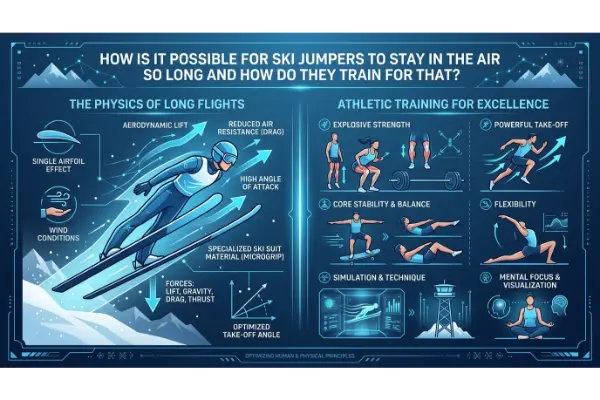
Watching ski jumping for the first time feels almost unreal. Athletes launch themselves off a massive ramp, soar hundreds of feet through the air, and appear to float far longer than seems possible.
At first glance, it looks like they’re flying.
But ski jumpers aren’t defying gravity. They’re using physics, aerodynamics, technique, and years of training to stay airborne for as long as possible.
The combination is so effective that elite ski jumpers can travel more than 250 meters (820 feet) in modern ski flying competitions.
Quick Answer
| Question | Answer |
|---|---|
| Why stay airborne so long? | Aerodynamics |
| Do they actually fly? | No |
| Main skill? | Body position |
| Key factor? | Lift generation |
| Training needed? | Years |
How Do Ski Jumpers Stay in the Air?
The simple answer is lift.
As a ski jumper moves through the air at high speed, air flows around their body and skis. By positioning themselves correctly, they create lift that partially counteracts gravity.
This doesn’t eliminate gravity. It simply slows the rate at which they fall.
The result is a long, controlled glide through the air.
Speed Is the First Secret
| Stage | Typical Speed |
|---|---|
| In-run | 85–100 km/h |
| Takeoff | Very fast |
| Flight | Gradual slowdown |
| Landing | Controlled |
Before leaving the ramp, jumpers accelerate down a steep track. Most elite athletes reach speeds between 85 and 100 kilometers per hour (53–62 mph).
That speed provides the airflow necessary to generate lift.
Without enough speed, the athlete would drop quickly after takeoff.
The V-Style Changed Everything
One of the biggest innovations in ski jumping history was the V-style.
Before the 1980s, jumpers kept their skis mostly parallel. Then athletes discovered that spreading the skis into a V shape dramatically increased lift.
Today nearly every elite jumper uses this technique.
Benefits of the V-Style
- More lift
- Better stability
- Longer flights
- Greater efficiency
- Increased distance
The improvement was so significant that jumping distances increased almost immediately.
Body Position Is Critical
| Position Element | Purpose |
|---|---|
| Head low | Reduce drag |
| Arms back | Improve airflow |
| Hips forward | Better balance |
| Skis angled | More lift |
| Stable core | Flight control |
Even small mistakes can cost several meters.
Elite jumpers spend years perfecting body positioning because tiny aerodynamic differences become extremely important at high speeds.
A slightly higher head position or poor ski angle can dramatically reduce flight distance.
They Don’t Just Jump. They Glide.
Many people imagine ski jumping as a giant leap.
In reality, the takeoff is surprisingly subtle.
Athletes don’t try to jump upward as high as possible. Instead, they focus on converting speed into an efficient flight path.
The goal is to enter the air smoothly while maintaining maximum forward momentum.
How Much Does Aerodynamics Matter?
Aerodynamics is everything in ski jumping.
Researchers have found that equipment design, ski position, body angle, and airflow can significantly influence performance.
Even the shape of the suit is tightly regulated because extra lift could provide an unfair advantage.
Aerodynamic Factors
- Ski angle
- Body posture
- Wind conditions
- Suit fit
- Air resistance
At the elite level, tiny aerodynamic advantages can determine winners.
What Happens During Flight?
| Flight Phase | Main Goal |
|---|---|
| Takeoff | Generate lift |
| Early flight | Stabilize |
| Mid-flight | Maximize glide |
| Final phase | Prepare landing |
| Landing | Maintain control |
Athletes constantly make micro-adjustments while airborne.
The movements are often so small that spectators don’t notice them, but they help maintain balance and optimize flight efficiency.
How Do Ski Jumpers Train?
Most people assume ski jumpers spend all day jumping off ramps.
That’s only a small part of their training.
Elite ski jumpers train year-round using a combination of physical conditioning, technical practice, and mental preparation.
Strength Training
| Focus Area | Purpose |
|---|---|
| Legs | Explosive power |
| Core | Stability |
| Hips | Balance |
| Back | Control |
| Shoulders | Positioning |
A powerful takeoff requires exceptional lower-body strength.
Athletes perform exercises such as squats, lunges, jumps, and explosive movements to develop the force needed at launch.
Plyometric Training
Plyometrics help athletes generate power quickly.
These exercises train muscles to produce maximum force in a short amount of time.
Common drills include:
- Box jumps
- Depth jumps
- Broad jumps
- Bounding drills
- Single-leg hops
The goal is explosive takeoff power.
Balance Training Is Essential
Ski jumpers spend much of their flight balancing on extremely narrow skis while traveling at high speed.
That requires outstanding body control.
Balance Exercises
- Stability boards
- Single-leg drills
- Bosu training
- Core exercises
- Coordination work
Many athletes devote hours each week to balance-focused sessions.
Summer Ski Jumping Exists
Many people are surprised to learn that ski jumpers train during summer.
Modern facilities use special synthetic surfaces that allow athletes to practice without snow.
This means elite jumpers can continue refining technique throughout the year.
Mental Training Matters Too
| Mental Skill | Benefit |
|---|---|
| Focus | Better execution |
| Confidence | Stronger jumps |
| Visualization | Improved technique |
| Calmness | Consistency |
| Decision-making | Better control |
Standing at the top of a giant ski jump can be intimidating.
Elite athletes regularly use visualization techniques and sports psychology training to improve performance and manage pressure.
How Far Can Ski Jumpers Actually Fly?
Distance depends on hill size, wind conditions, athlete skill, and competition rules.
Elite ski flyers regularly exceed 200 meters.
The current world records are well beyond 250 meters, making ski flying one of the longest non-motorized aerial sports in the world.
Is Ski Jumping Dangerous?
Like many winter sports, ski jumping carries risks.
However, modern equipment, improved hill design, strict regulations, and advanced training methods have made the sport significantly safer than in previous decades.
Professional athletes spend years developing the skills needed to handle the physical demands safely.
Final Thoughts
Ski jumpers stay in the air so long because they use speed, aerodynamics, body positioning, and lift to slow their descent. They’re not flying like birds or airplanes, but they are taking advantage of the same physical principles that make flight possible.
What looks effortless on television is actually the result of thousands of training hours, intense strength work, balance training, technical practice, and precise control in the air.
The next time you watch a ski jumper glide hundreds of feet through the sky, remember that you’re seeing one of the most remarkable combinations of athletic skill and physics in sports.
Frequently Asked Questions
How do ski jumpers stay in the air so long?
They generate lift through aerodynamic body positioning and ski placement while traveling at high speeds.
Do ski jumpers actually fly?
No. They glide through the air by slowing their descent rather than producing sustained powered flight.
How fast are ski jumpers going?
Most elite athletes reach speeds between 85 and 100 km/h before takeoff.
Why do ski jumpers spread their skis apart?
The V-style increases lift and allows longer flight distances.
Do ski jumpers train year-round?
Yes. Most athletes train throughout the year, including summer.
What muscles are most important in ski jumping?
The legs, core, hips, and back play major roles in takeoff and flight stability.
How far can professional ski jumpers travel?
Elite ski flyers can exceed 250 meters under ideal conditions.
Is ski jumping harder than it looks?
Absolutely. The sport requires a unique combination of strength, balance, precision, courage, and aerodynamic control.